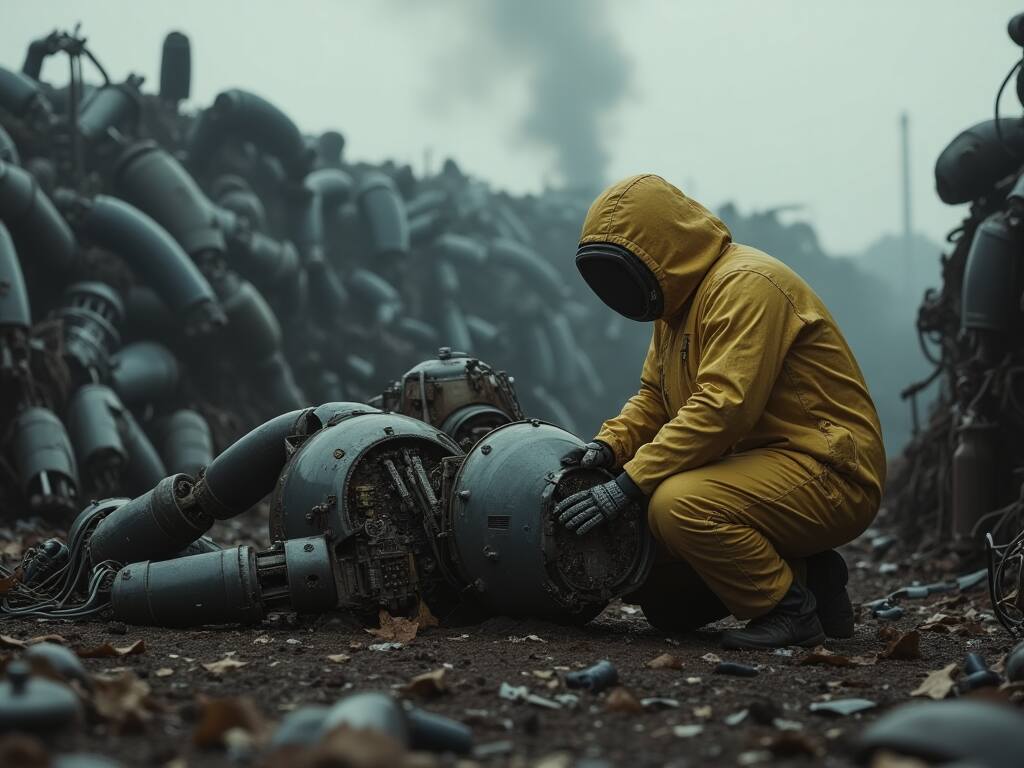
Introduction: The Automation Boom’s Dirty Secret
Go into any contemporary factory and there they are– shining robotic arms building cars, wrapping and wrapping products, even doing surgery. Robotics is a booming market with the worldwide sales reaching 553,000 units in the year 2023 (IFR). However, this is the sad reality that no one is complaining about: What when these robots die?
As opposed to the smartphone that you discarded, industrial robots cannot be simply thrown into the trash: they are heavy, greasy, wires-stuffed, multi-ton monstrosities containing all sorts of poison. And at this moment, the percentage of correct recycling is no more than 20 (GreenBiz). The rest? Exports to scrap dealers in Ghana, melted down in back-street furnaces, or thrown away in warehouses.
It is not only an environmental concern but a time bomb of an industry that boasts of being innovative. Unless we take action very swiftly, it is those same machines that will support a high tech world that will create a toxic wasteland.
The Robot Graveyard: Why Industrial E-Waste Is Worse Than You Think
Believe your Iphone was difficult to recycle? Figure out how to take apart a 2-ton KUKA assembly bot that has hydraulic fluid leaks and black-box robotic controllers with proprietary stuff. The majority of the recycling companies will not even take them.
- Each fanuc m-710ic robot is loaded with 50 + pounds of rare-earth magnets, copper wire, and lead-based solder-and there is no simple mechanism of separating them.
- Case Study: In 2023, the German car producing factory scrapped 120 robots; 17 of them were recycled. The rest? The shipment was sold to a so-called broker who sent them to India to be refurbished (instead they were stripped of their metal to be sold as scrap).
Dr. Linda Lee (MIT Environmental Robotics Lab) says “We are getting robot graveyards emerging, near industrial areas.” It is not a case of metal skeletons, but chemical hazards.
The Global E-Waste Pipeline: From Factories to Toxic Dumps
Just trace where the dead refurbished robots orginates and you are there at more notorious places like Agbogbloshie, Ghana where e-waste is dumped. In this case, laborers use blazing pits to burn the robot parts to recover the copper inhaling the carcinogenic fumes at a daily rate of 3 dollars.
- Inquiry (Robotics Tomorrow): Most of the corporations dispose with their outdated bots through the recycling middlemen-with full knowledge that they will be tossed in other countries.
- Real-World Example: A leaked report released in 2024 indicated that one in every three recycled (in the U.S ) industrial robots went to the Nigerian abandoned scrapyards.
“It is always the same old game rich countries automate and the poor countries pick up the pieces.“
— Carlos Montero Former Fanuc Engineer
Who?s Fighting Back? and who is not listening/to the issue)
Not every company is making a blind eye. The take-back program implemented by ABB re-claims 90 percent of old bots material. In parallel, small factories have demonstrated that reconditioned robots can be up to 50 per cent less expensive than new ones (startups such as ReBotz in Germany).
But there is Tesla. The Optimus humanoid robot claims to be environmentally-friendly. However, its glued-in batteries and not-modular joints-making fixing the robot almost impossible. “It is ‘planned obsolescence’ in an expensive machine that costs 20,000 dollars,” says a former Tesla robotics engineer (and wishes to remain anonymous).
The Policy Gap: Why Nobody’s Forcing Change
The EU is currently ahead of the Right-to-Repair laws on industrial robots and the U.S. is way behind. According to the Robotic Industries Association (RIA), the recycling should be a business driven process. However, if there is no financial reward, it is usually thrown into a trash bin.
- Germany said: Requires a 10+ years spare part support of industrial robots.
- U.S. Reality: No federal regulations on recycling of the robots, only voluntary principles are set.
Conclusion: The Industry’s Make-or-Break Moment
This is the cold reality of it. Robotics cannot afford to describe itself as the future, whilst simultaneously causing diseases in the present. We need:
- Tough recycling policies (No more loopholes).
- Stop glueing in batteries! It takes modular robots.
- Any measure of transparency (Where dead bots really end up).
“Either we make lasting robots or we know we are just making fancy garbage.” MIT-Dr. Lee,
Final Thought:
Do non recyclable robots need to be banned by governments? Or will this mess be solved by free market?