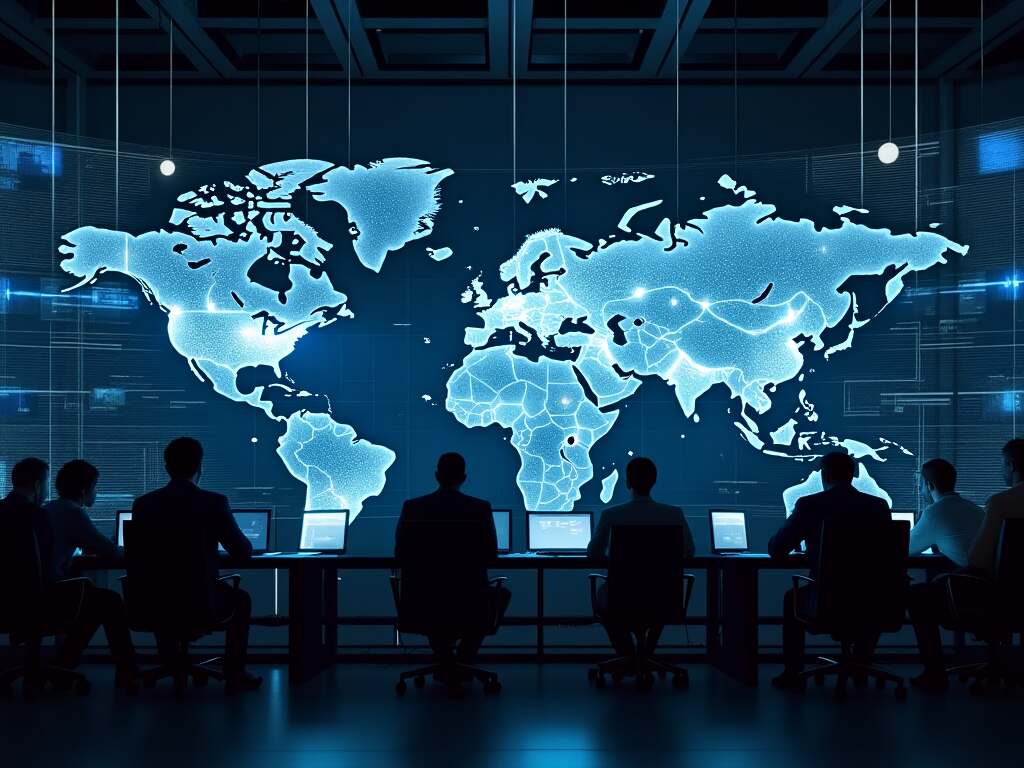
When the specters of a cyberattack appear, to whom do we go? The new fighting fronts in the current environment are not solitary initiatives-but threat-intelligence sharing platforms. They rearrange scattered protection into a network of strength. What people claim as right, statistics can prove there is a quiet influencer in the cybersecurity world. Let us take a stroll and see how with the help of substantial numbers and the viewpoints of experts this community is reinventing cybersecurity.
Rising Storm: Threat to Essential Facilities
Would you ever have thought that one nation could receive hundreds of attacks by a day? Such monstrous increase is now a reality with power grids, water systems,and even hospitals being targets of advanced campaigns. Commissions within the government are collaborating with private industry in turn, building dual cybersecurity centers that can intercept nearly every incoming attack. And that, in a nutshell, demonstrates the stakes: the threats that nation-States pose are no longer hypothetical–they are constant, persistent and are adapting.
Breaking Down Silos: Why Sharing Intelligence Matters
What is the point in playing alone, when group defense is more severe? Historical cybersecurity has been fractured–neighboring tools, tribal cultures and organization divisions between government and commercial enterprise. The platforms of threat-intelligence sharing alter the equation to enable organizations to be quicker and more accurate in their actions. Its like going from personal firewalls to a neighborhood watch except real time and global. Permitting mostly gathering information on innovative malware strains, phishing techniques, and network weaknesses and then patching the shortcomings far before they can be exploited, these systems enable patch fixes to be identified sooner.
Within the Hub: World Stories Harmonised Ecosystems
Perhaps the finest example of this model is the way that states and local governments in the U.S. now come within the shared umbrellas of state-level and local level defense, being provided with real-time intelligence, as well as intrusion detection mechanisms and even domain-blocking services entirely gratis. At the financial front, almost 7,000 banks and financial institutions collaborate on the global level sharing with each other actionable alerts and patterns to avoid fraud and those who attempt to disrupt them. That level of scale does not come over night-it occurs through the trust which can be gained by all benefiting when a breach is averted at early stage. The larger a network is, the greater is the shield.
When Threats Become Invisible: The Fox Acid Scenario
Ever curious what it might feel like when you are blind sided? That is how defenders have characterized encountering low-profile attacks like the Fox Acid zero-day exploit platform. These attacks circumvented all of the more conventional means of detection–no signature, no clear indication of infection. The only measure which exactly worked was AI-based behavior detection capable of detecting imperceptible irregularities and halting attacks before their spread. It reminds us that in this age there is a class of dangers meant to hide until their complexity is revealed by united intelligence.
Shaping Policy: Bridging Private and Public Strategies
Policy is moving in a catch up mode. In some countries, the exchange of intelligence has been institutionalized through legislations with the government and industry operating hand in hand. Other parties are redesigning procurement policies such that cyber security safeguards encompass open cooperation lines. It is a basic concept, resilience is not only about good firewalls but partnerships. Aligning regulation with collaboration governments are beginning to build digital ecosystems that perform more as a network coalition than outposts.
Personal Perspective: Why This Feels Like the Dawn of Digital NATO
Now comes my part in the story. I have witnessed the effects of sluggish, helter-skelter response to siloed teams. In intelligence-sharing ecosystems however, threats that cross industries are neutralized practically before most stakeholders can be aware of their existence. Network effect is not an abstract concept to describe but a life-saving phenomenon. Assuming that NATO exists in the real world then threat-intelligence sharing ecosystems are the digital cousin: a shared defense to the digital era.
Future Outlook: Can AI and Sharing Evolve Together?
There is disagreement among the cybersecurity professionals on whether AI is biased towards the attackers or the defenders. Attackers already use it as part of their reconnaissance and malware generation. Defenders use it as part of their anomaly detection and predictive alerts. Visualize now a few platforms that combine the two: The signals coming to AI-enhanced global intelligence, automatically chomping down on millions of endpoints to raise alarm to the local operators before any damage is incurred. And that is not a vision of what will be done someday–it is beginning to happen now. It may become a paradigm shift in how collective defense is done.
Final Thought: What Will You Bring to the Table?
This is the lesson then: insofar as cyber defense is becoming collective, the question should no longer be whether to join in or not. It is the question of what I will have to give out. Communal intelligence is not passive–it is our shared benefit. This is a digital world, and collaboration is resilient. It is not all about being saved, it is about shared innovation towards the future of cybersecurity.