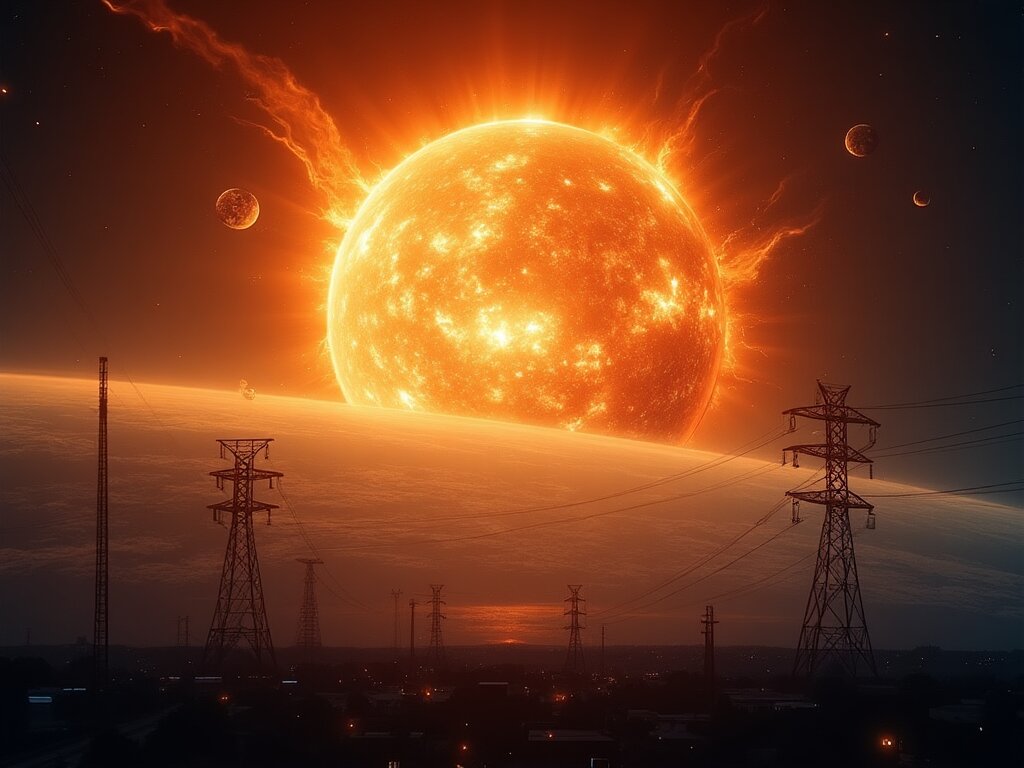
A Brush With Disaster
On May 10, 2024, the Sun released an X3.4 class solar flare, or one of the most powerful in years. It took only a few hours until a coronal mass explosion (CME) was flying towards the planet at a speed of 1.8 million mph and it could destroy satellites, power grids and even the internet. A state of geomagnetic storm G4″Severe”, the highest alert in nineteen years since 2003 was issued by NOAA. but, hear the scary thing: we were lucky. At a different magnetic alignment, the storm could have produced a Carrington-scale event which would have been a multi-trillion dollar disaster.
So how near did we get to a blackout? Why do scientists claim that the next one might be much worse?
What Actually Happened is the 2024 Solar Storm?
The storm was triggered when sunspot AR3664, an unstable area 15 times the size of the earth emerged. As it broke out, Solar Dynamics Observatory at NASA recorded a bright burst of intense UV light rays- a clear indication of an X-class flare. The resulting CME hit the magnetic field on May 12 resulting in a wave:
- Starlink satellite interference (Elon Musk said, after confirmation of some interference, there was degraded performance).
- Aviation and shipping using GPS errors (FAA issued advisories).
- Texas, Spanish, and New Zealand auroras–an unusual occurrence so low on the latitude.
The actual worry is? The electricity system. In Canada, the Hydro-QuEbec–which was still traumatized by the 1989 blackout–ran into emergency measures. Swedish grid operators noticed overheating of transformers, which causes impending failure.
“This is a shot across the bow, according to Dr. Tamitha Skov (Space Weather Woman). Had the magnetic field of the CME been aligned southwards, one would have been talking about blown transformers and outages as long as several months.”
Near-Miss: How Fragile Our Grid
So here is the bad news: Our systems are sitting ducks.
- Transformers are the Achilles heel. As opposed to electronics these multi ton beasts take 12-18 months to build. A recent 2013 Lloyd study predicted that 20-40 million American people could be left without electricity in case of a Carrington-level storm, up to 2 years.
- The internet cables laid underground are susceptible. The constant exposure to solar-induced currents might burn out repeaters cutting the chain of the world into pieces. Even a large enough storm may take down the internet weeks, cautions Dr. Sangeetha Abdu Jyothi (UC Irvine).
Case Study: Quebec Blackout of the 1989
- Less than 92 seconds after a much smaller solar storm (G5) broke hydro-Quebecs grid.
- It left 6 million without power 9 hours in freezing weather.
In this age of hyper-connectivity, a fallout of such intensity would be exponentially more severe.
Why the Next Storm Could Be Catastrophic
We are already in the solar maximum (2025-2026) which means an increase in the flare activity. But the majority of the countries are unprepared:
- There are no compulsory Faraday safeguards (Electromagnetic pulse shielding) in the U.S. grid.
- According to ESA reports, early-warning system in Europe lacks sufficient funding.
- The growing satellite networks of Asia (such as the BeiDou in China) undergo untested dangers.
Expert Insight: “We’re Gambling With the Sun”
“The storm of 2024 was a G4. This was the Carrington Event? A G5+. We are aware that such a storm will knock again-it is something or another about the time.”
Dr. Scott McIntosh (NCAR) –
How to Prepare (Before It’s Too Late)
One country at least is coming to its senses:
- Finland currently protects the vital transformers using an alloy as a non-magnetic steel cover.
- In the UK, National Grid has underground bunkers, with spare parts.
- Satellites are being made radiation-resistant by private companies such as SpaceX.
But globally? Not much is moving. Only 15 percent of utilities were reported to have storm-response plans according to the 2023 report of the U.S. FERC.
Conclusion: Will We Act—Or Wait for Darkness?
The storm in 2024 was a practice one. The second one may rewrite the history.
Final Thought:
We dampen earthquakes. We plan ahead of hurricanes. But we do not pay attention to the Sun–the only force which can boil civilization to a frying pan within a single day. Will we at last begin taking space weather seriously, or again roll the dice?
Discussion:
- And must solar storm prep become enforced such as earthquake codes?
- Would Bitcoin withstand a months outage of the internet?
- What would you do without electricity a year?