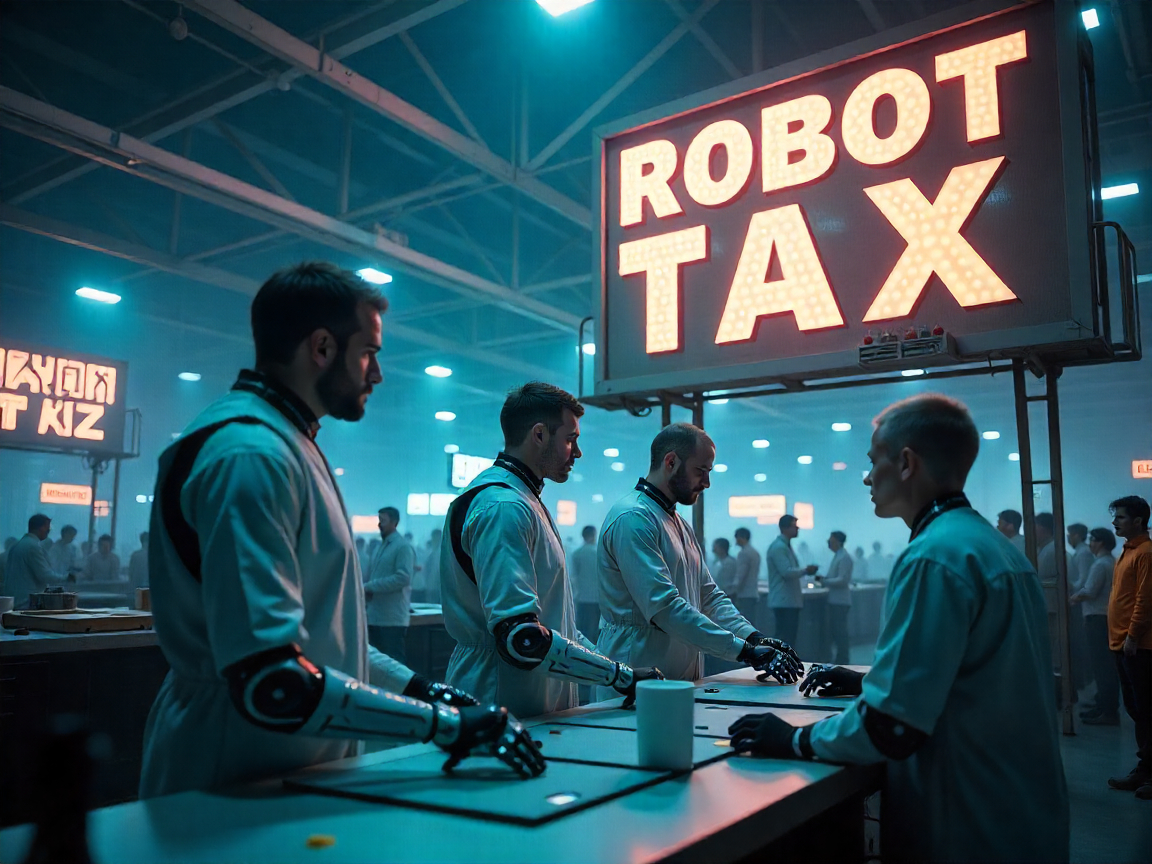
There is nothing futuristic about Automation: it is being done, here and now. Go to an Amazon warehouse and you will find that there are thousands of robots buzzing around, transporting goods faster than any human being. Come 2024, the e-commerce giant had installed 750,000 or more robotic systems, reducing labour requirements at certain locations by 30 per cent. In the meantime, economists forecasted that AI and robotics are likely to eliminate 14 percent of worldwide jobs by 2030.
With the robots taking peoples places at jobs, there has been a very heated debate on whether the robots should be taxed to manage the job losses incurred or the employees should be taxed. Its advocates say that to give retraining and social nets money should be found. The opponents labelled it as a roadblock to innovation. Who’s right? Kind of a good time to.
The Case for a Robot Tax: Protecting Workers in the Age of Automation
Consider an example where a worker has been at a factory throughout his or her life span of 20 years, and the first thing he or she sees in the morning is a robotic arm dislodging him or her. That is the situation with millions of people. According to a study made by MIT in 2023, every industrial robot that has been created introduces the destruction of 3.3 jobs on average- with the most significant impact being to low-skilled workers.
This is not only regarding lost wages. When a job is lost the whole community is hurt. Tax revenues decline, cost of social services escalate and inequality gets prominent. In 2017, Bill Gates made a notorious argument that, in case robots steal people their jobs, companies ought to pay tax in order to take care of dislodged employees. The concept is taken seriously in South Korea, where the country is the first to scale back tax incentives on automation investments-an invisible robot tax.
Is this model applicable in the rest of the world? According to the proponents, the answer to this question is yes and gives examples of experimentations with the universal basic income (UBI) in Finland, where the workers were sponsored with direct cash benefit allowing them to adapt to new jobs. However, the opponents do not believe it.
The Backlash: Why Tech Leaders Say a Robot Tax Will Backfire
What did Silicon Valley do about this? Taxing robots is the equivalent of taxing tractors in the 1800s and that is punishing progress. After having cautioned against overregulation because such would discourage innovation, Elon Musk is not the only person to have done so. AI and robotics could generate an extra $15.7 trillion to the world economy by 2030, auguring an estimate by a 2024 PwC report. Critics of this idea say that reducing growth by taxation may cause whole industries to become less competitive.
Consider the case of Germany which has one of the most automated manufacturing sectors in the world. Perhaps due to all the use of robots, unemployment is at an all-time of 3 percent (2024). Why? Since Germany is investing in upskilling of workers, there is no penalty in automation.
Even so, a sense of foreboding prevails: What will happen when 3.5 million U.S. drivers are supplanted by self-driving trucks? Or when paralegal- destroying AI legal tools annihilate the sectors? Blanket robot tax might not be the solution but not doing anything isn too.
Alternative Solutions: Beyond Just Taxing Robots
Some policy makers are mulling over more intelligent alternatives:
- Automation Impact Fees (Suggested in California, 2024): Based on the amount of employees laid off, every company will contribute a certain amount of funds that will be used in local hiring schemes.
- Enforced Profit-Sharing: In case of an increase in profits when robots are at work, the workers receive a fraction.
- Lifetime Learning Accounts: Employee rescue by government reskilling funds.
Dr. Kate Darling (MIT Media Lab) proposes a new idea, that is, it is not automation that should be punished, but rather be rewarded when companies trained their employees rather than laying them off.
The Global Experiment: Who’s Testing a Robot Tax?
No nation has an actual robot tax but there are countries that are flirting with the concept:
The Automation Transparency Act (2024) in San Francisco requires any company that intends to implement the use of robots to report job losses.
As an alternative, EU has been advocating a Digital Levy where revenues generated by AI would be taxed at 3% to redistribute tech riches.
Japan pursues another direction by subsidizing the human-robot work in nursing and the building industry.
Final Verdict: A Necessary Evil or a Flawed Fix?
The case against a robot tax is not economic, but about what we decide to become. Do we allow the automation to take its course and they leave the workers behind? Or should we dare kill innovation by means of high taxation?
That is the reality: a clean robot tax is too simplistic. Neglecting the displacement crisis is thoughtless, however. Which is the better way? Hybrid approaches- Making it more expensive to over automate when the corporation fails to re-train their employees. They also encourage the development and adoption of job-creating technology.
Do You Think?
- Is Amazon supposed to pay to have each human job taken up by a robot?
- Or maybe we should rather concentrate on reskilling programs?
Post your ideas in the comments–we should argue about future of work.