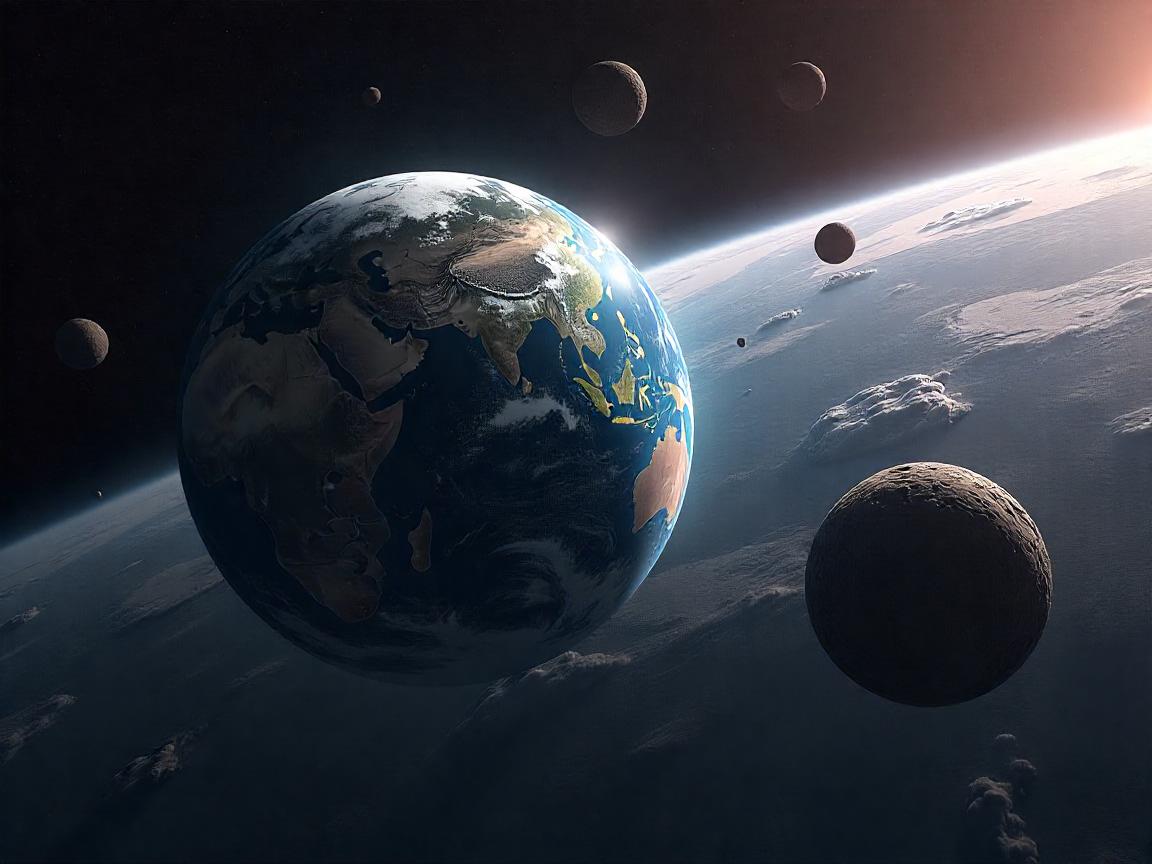
Earth’s Secret Satellites
Imagine thinking that the night sky we see doesn’t always have just one natural satellite, our Moon. In some cases, small asteroids are drawn into Earth’s gravity which turns them into temporary borrowed stars known as “minimoons.” Visiting objects only stay around our planet briefly before progressing around the Sun. The exploration and analysis of minimoons excite scientists and open up many unique opportunities for both exploration and research.
What Are Minimoons?
Occasionally, small near-Earth asteroids called minimoons are held by Earth’s gravity for a short interval. Although the Moon never leaves its orbit, these objects generally measure about three meters across and will remain there for a few months or years, sometimes going back into solar orbit. Because of how transient they are, it can be complicated to find and study them.
No more than a handful of minimoons have so far been verified:
- RH120 was discovered in 2006 and orbits around Earth for more than a year, till it leaves Earth’s bay.
- In February 2020, 2020 CD3 was identified by the Catalina Sky Survey and spent four months in orbit around Earth, exiting in May of the same year.
- In 2022 NX1 and 2024 PT5, more recent discoveries added to our understanding of photonics.
It’s apparent from the study, that Earth can catch these residual objects often, even when they usually go unobserved.
Identifying and Watching Minimoons
It is not easy to find minimoons. Being small and weak signals, they are not easy to observe through telescopes. Still, recent progress in observation tools has allowed us to achieve more. Using its 1.5-meter telescope on Mt. Lemmon, the Catalina Sky Survey made the discovery of 2020 CD3. After spotting them, astronomers study the orbits of these objects to confirm they are only temporary satellites of the Sun.
With its new Legacy Survey of Space and Time (LSST), the upcoming Vera C. Rubin Observatory might help spot and monitor a lot more transient objects, thereby revealing additional minimoons for scientists.
Why Minimoons are Important in Science
Minimoons can help us understand both what near-Earth objects contain and how they perform. Because they are only reachable for a short time, they give us a rare chance to look at materials that might have originated in the asteroid belt or on the Moon. Scientists have found that minimoons created in the Moon by crashes may be dragged into orbit by Earth’s gravity.
Understanding these objects can reveal the ways Earth interact with gravity and how asteroids begin and finish their journeys with us. Besides, studying minimoons gives us the opportunity to test models we use for understanding orbits and defence against threats.
Minimoons and the Next Missions to Space
Besides being curious about them, minimoons have applications for planned missions into space. Premiering in the inner solar system, asteroids are suitable for testing spacecraft devices, collecting returns from them and learning how to mine asteroids. According to MIT astrophysicist Richard Binzel such objects could serve as easy targets for spacecraft seeking to explore places beyond the solar system.
Minimoons give an opportunity to improve techniques for redirecting asteroids and for using their resources, both essential for future space programs.
Expert Insights
Specialists in space exploration point to the positive role minimoons have in improving our ability to reach space. Robert Jedicke, an astronomer at the University of Hawaii, points out that minimoons make missions to explore asteroids more achievable, as they bring the asteroid belt nearer to Earth. Studying these interactions may encourage progress in building spacecraft, self-guided navigation and the use of nearby resources.
Embracing Earth’s Temporary Buddies
Despite their brief visits, Minimoons create many opportunities for people to learn more and improve technology. Their research helps us understand near-Earth objects, improves ways to defend from asteroids and prepares for future missions to explore outer space. With better methods of detection bringing up more minimoons, using these temporary satellites could help us go further in exploring the universe.